

Resin Technology / Ion Exchange Technology
An ion-exchange resin or ion-exchange polymer is a resin or polymer that acts as a medium for ion exchange. It is an insoluble matrix (or support structure) normally in the form of small (0.5–1 mm diameter) microbeads, usually white or yellowish, fabricated from an organic polymer substrate. The beads are typically porous, providing a large surface area on and inside them. The trapping of ions occurs along with the accompanying release of other ions, and thus the process is called ion exchange. There are multiple types of ion-exchange resin. Most commercial resins are made of polystyrene sulfonate.
Ion-exchange resin beads
Ion-exchange resins are widely used in different separation, purification, and decontamination processes. The most common examples are water softening and water purification. In many cases ion-exchange resins were introduced in such processes as a more flexible alternative to the use of natural or artificial zeolites. Also, ion-exchange resins are highly effective in the biodiesel filtration process.
Softner
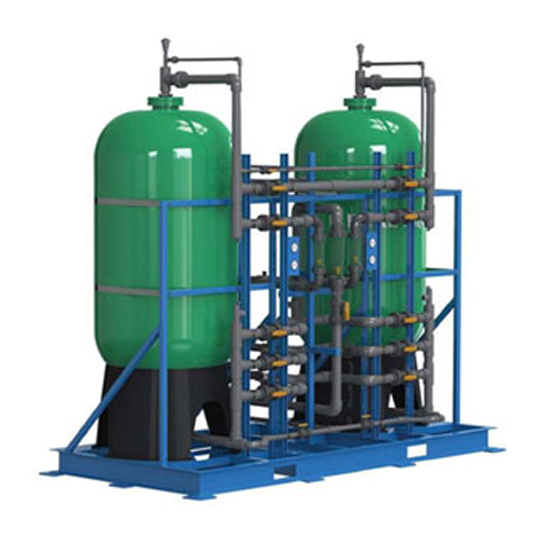
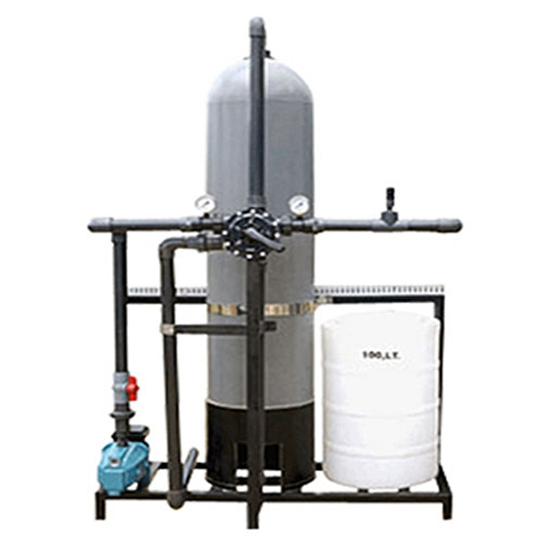
A softener system consists of a bed of resin beads with the ability to pick up hardness by ion exchange (hardness exchanged for “softness”). It can then be regenerated by a high concentration (10% brine) of salt to restore its capacity. The system can be used over and over for many years. Water hardness is usually commonly reported in ppm (parts per million) or mg/l (milligrams per liter as CaCO3 (calcium carbonate), and fortunately 1 ppm = 1 mg/l.
The term CaCO3 defines a convention representing the number of ions to be exchanged. The water analysis is usually presented in mg/l (as the ion) which has to be converted to mg/l as CaCO3 using conversion factors. The factor for Ca++ is 2.5. To get mg/l as CaCO3, multiply the mg/l as Ca++ by 2.5. For Mg++, the factor is 4.1. Once calcium and magnesium as CaCO3 is calculated, add them to get total hardness (as CaCO3). Resin capacity will vary depending upon the salt dose per cubic foot of resin and can be approximated from the following table.
DM Plants
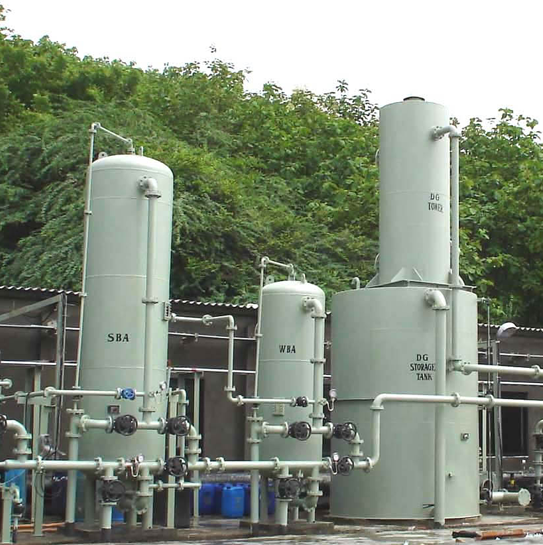
Demineralized water also known as Deionized water, water that has had its mineral ions removed. Mineral ions such as cations of sodium, calcium, iron, copper, etc and anions such as chloride, sulphate, nitrate, etc are common ions present in water. Deionization is a physical process which uses specially-manufactured ion exchange resins which provides ion exchange site for the replacement of the mineral salts in water with water forming H+ and OH- ions. Because the majority of water impurities are dissolved salts, deionization produces a high purity water that is generally similar to distilled water, and this process is quick and without scale buildup.
De-mineralization technology is the proven process for treatment of water. A DM Water System produces mineral free water by operating on the principles of ion exchange, Degasification, and polishing. Demineralized Water System finds wide application in the field of steam, power, process, and cooling.
Principle : Raw water is passed via two small polystyrene bead filled (ion exchange resins) beds. While the cations get exchanged with hydrogen ions in first bed, the anions are exchanged with hydroxyl ions, in the second one.
Process : In the context of water purification, ion-exchange is a rapid and reversible process in which impurity ions present in the water are replaced by ions released by an ion-exchange resin. The impurity ions are taken up by the resin, which must be periodically regenerated to restore it to the original ionic form. (An ion is an atom or group of atoms with an electric charge. Positively-charged ions are called cations and are usually metals; negatively-charged ions are called anions and are usually non-metals).
The following ions are widely found in raw waters :
Cations |
Anions |
Deionization :
For many laboratory and industrial applications, high-purity water which is essentially free from ionic contaminants is required. Water of this quality can be produced by deionization.The two most common types of deionization are :
Two-bed deionization : The two-bed deionizer consists of two vessels - one containing a cation-exchange resin in the hydrogen (H+) form and the other containing an anion resin in the hydroxyl (OH-) form. Water flows through the cation column, whereupon all the cations are exchanged for hydrogen ions. To keep the water electrically balanced, for every monovalent cation, e.g. Na+, one hydrogen ion is exchanged and for every divalent cation, e.g. Ca2+, or Mg2+, two hydrogen ions are exchanged. The same principle applies when considering anion-exchange. The decationised water then flows through the anion column. This time, all the negatively charged ions are exchanged for hydroxide ions which then combine with the hydrogen ions to form water (H2O).
Mixed-bed deionization :In mixed-bed deionizers the cation-exchange and anion-exchange resins are intimately mixed and contained in a single pressure vessel. The thorough mixture of cation-exchangers and anion-exchangers in a single column makes a mixed-bed deionizer equivalent to a lengthy series of two-bed plants. As a result, the water quality obtained from a mixed-bed deionizer is appreciably higher than that produced by a two-bed plant.
Although more efficient in purifying the incoming feedwater, mixed-bed plants are more sensitive to impurities in the water supply and involve a more complicated regeneration process. Mixed-bed deionizers are normally used to ‘polish' the water to higher levels of purity after it has been initially treated by either a two-bed deionizer or a reverse osmosis unit.
Major Applications :
- Boilers feed water, Textiles, Pharmaceuticals, Chemicals, Breweries, Swimming pools, Potable Water, Hospitals, Automobile, and Battery, Fertilizers.
- Ion Exchange Plants
- Softener
- Industrial DM Plant
- Two Stage & Multi Stage DM Plants
- Mix Bed Demineraliser
- De-Gasifiers
- Cation Polisher
- Manual/Automatic Plants
- Pharmaceutical Industry
- Power Plant
- Oil & Gas sector
- Chemical Industries
- Textile Industries